Want Quick Happy tips? Head over to Marc and Angels Hack

Practical Tips for Productive Living - Wonderful Quick and effective reading articles around the wellbeing, happiness and positiveness in bullet points numbers. I personally use it for easy reference

Want quick inspiration? Inspiration Peak is the place to go!

Check out and subscribe to Inspiration Peak in my Fav Websites for everyday quotes. Works a charm every single day. You're more than welcome to suggest a quote too!

Mind, Body, Green - Ultimate Wellness articles

I love their articles for it is written by various authors coming from wellbeing, yoga, holistic nutrition background that brings you closer to nature and serenity...

Lifehacker - Tips, tricks, and downloads for getting things done

Slightly drawn towards IT tips but they do also have tips about anything and everything you need under the sun, including tips for baking and cleaning! Check them out

Showing posts with label Videos. Show all posts

Sunday, July 23, 2017

Stretching Doesn't Work (The Way You Think It Does)

This is so interesting and it does makes a lot of sense. The body will lengthen only the mind is ready.

Original post here.


Does stretching make you more flexible? I know the obvious answer to this question, based on what we’ve all been told about the merits of stretching, is, “Duh! Yes!” But it turns out that might not be the case. But it might be the case. At least a little. But not totally. Okay, let me explain.


Stretch Your Bits or Stretch Your Mind?

I’ve had a few things come up recently that have me rethinking the common stretching belief that goes something like this: stretch tight bits in your body and they will get longer/more flexible/more supple.

The things that have me rethinking this are:

  1. An interview I did on the Liberated Body Podcast with Jules Mitchell who is writing a book (and just finished a thesis) on the science of stretching.
  2. A guide I am putting together on how to resolve short hamstrings (it’s out on Liberated Body in October), which had me immersed in the research about how hamstrings specifically manage to return to a more functional length.
  3. And last but not least, I am reading Katy Bowman’s new book Move Your DNA where her insights on sarcomeres have my attention (plenty of other things too, but I’m already trying to keep this post from becoming epically long).

I’ll do my best to summarize the a-ha moments that have sprung out of these three things.

Your Nervous System Runs the Show

In her interview with me, Jules Mitchell* talked about how she began her thesis with the intention of taking a biomechanical view into yoga asana, which is exactly what she does. However, because she started her work from the perspective of a yoga teacher- with all the training that had told her that stretching leads to increased flexibility, she was surprised to discover that the research on stretching did not bear this idea out.

She discovered this idea - that if we stretch more and stretch harder that our tissue will change - was untrue. In reality, we are not lumps of clay that can be molded by persistently tugging on things. This is because our nervous systems are running the show.

So what does that mean? That means that unless you are under anesthesia (where you will miraculously gain full and even excessive range of motion, but I do not recommend attempting to go through life under full anesthesia simply for its flexibility gains), your ability to stretch at any range is determined by your nervous system’s tolerance to that range.


As in, when you have super short hamstrings and you try to forward fold and meet rigid resistance, it is not that you need to pull on your hamstrings like they are inanimate taffy, because you can’t. Your nervous system is the thing giving you that firm end range, and it’s basically saying, “Nope. Sorry buddy. I don’t feel safe there, so I’m not going to let you go there.”

Getting pushy about it and trying to force your hamstrings into ever deeper end ranges will have one of three outcomes:

  1. Nothing will change
  2. Your hamstrings will get shorter
  3. You will injure your tissue (which, P.S., has about a two-year healing period if we’re talking about a tendon injury).

I recommend not trying to force override your nervous system on issues of flexibility. It will win. It will be unpleasant.

Your Body's Emergency Brake

Why would the nervous system not feel safe and therefore limit your mobility? Because that range is unfamiliar, or because compensatory patterns in your body have determined that certain parts of you need to function as an emergency brake in order to hold it all together (and of course these two things are not mutually exclusive). Both boil down to issues of motor control (plenty more to chew on here) and of Davis’ Law, which can be (over) simplified to, “use it or lose it.”

While working on the Liberated Body Short Hamstrings Guide, I kept coming back to the issue of how the hamstrings function, in some chronically short-hamstringed people, as an emergency brake. This kind of compensatory pattern happens for plenty of reasons, but top among them might be under active deep core musculature, too rigid core musculature (yes, underactive and too rigid can come together), weakened adductors, and more. If these or other key stability structures can’t fully do their job, the hamstrings are at the ready. They sub in for a lack of support elsewhere by battening down the hatches.

To go back to the emergency brake analogy - if your car were parked on the edge of a cliff and was held there only by its emergency brake, would you release it? Not if you are sane. This is the same decision your nervous system is making when you attempt a forward fold and are stopped prematurely.

brooke thomas, stretching, flexibility, mobility, stretching doesn't work


Those Naughty Sarcomeres

In regards to the use-it-or-lose-it part of the flexibility equation, let’s talk Katy Bowman**, moving your DNA, and the sarcomeres. Bowman has been a champion of getting people to understand the difference between frequency and intensity. In short, that what we are doing with our bodies most of the time thoroughly trumps how hard we may be capable of working out (or stretching) for a small portion of our day. In relationship to flexibility, this means that if we, for example, sit in a chair with our hamstrings contracted from both ends all day long, we will gradually develop short hamstrings.

Here is an extremely pared down, Cliff’s Notes version of Bowman’s writing in Move Your DNA on the role the sarcomeres play: Sarcomeres are the basic contractile units of our muscles. Muscles move because sarcomeres generate force and move. When you are often in the same position - as with our contracted-hamstrings-in-the-chair example - your sarcomeres change on the cellular level in a way that makes it easier for you to do more of what you are already doing. Yes, those naughty sarcomeres will actually cannibalize themselves and grow themselves to set your chair-shape as your new normal.

brooke thomas, stretching, flexibility, mobility, stretching doesn't work

That said, the way to approach rehabilitating this would be to move with more normal hamstrings length more frequently. For example: to use a standing desk for all or part of the day, to sit on the floor with our legs outstretched in front of us (if we can accomplish that without rounding our backs, another symptom of short hamstrings), wearing neutral-heeled shoes, and to walk and to take frequent movement breaks, among other things.

The road to rehabilitation would not look like stretching the bejeezus out of your hamstrings at their absolute maximum end range for somewhere in the neighborhood of thirty and ninety seconds per day.

Bringing Mitchell’s and Bowman’s work together, this kind of rehabilitation accomplishes a few key things. First, it reminds your little sarcomeres what length you would like things to be by gradual, incremental loading of your body in healthier ranges of movement. Second, taking more opportunities for natural movement more frequently (oversimplified definition alert: natural movement = accomplishing the movements that our ancestors used to need to do to survive - like walking, or bending, or climbing - with proper alignment) develops strength and adaptability. This allows your nervous system to feel safe about testing out new ranges of motion, while simultaneously unraveling the compensatory patterns that make your nervous system put on the brakes in the first place.

A Tale of Two Feet

What might this look like in practice? Let me tell you about my feet. Last summer I still had to slap on my rigid hiking shoes in order to get out on the rocky trails here in New England. Whenever I attempted to wear a more flexible-soled shoe, I was one sore-footed girl. Determined that my feet could be more supple, I spent the year wearing only neutral-heeled, flexible-soled shoes, taking plenty of barefoot time, increasing my walking mileage, and intentionally seeking out as much diverse terrain as I could find.

Fast forward to the end of this summer and I have been hiking daily - up steep inclines, on slick shale, on rocky ground and tangled stumps - only in my UnshoesAnd what’s amazing is that these hikes also manage to feel like a delicious foot massage no matter how long I’m out on the trail. I find myself intentionally stepping on the rockier areas of the trail because it feels good on my feet. What happened there?

I incrementally - over one year - loaded my feet differently, and as a result the 33 joints that live in my tootsies are now much more supple and flexible. My feet are also stronger. Flexible and strong like to show up to the party together. Go figure.

Some Stretching Movement Rules to Live By

So is stretching the devil? Nah. Frequent, intermittent stretching that is within your range and not red-lining it for your abilities helps you to explore your movement ranges and therefore helps you to (very gradually) remodel yourself at the cellular level to a more mobile version of yourself.

This is a complex issue for which much more could be said, but I have already written a short novel, so in closing here are a few bullet points that we might want to consider so that we can re-frame how to become more flexible. Perhaps we should:

  • Stop with the no-pain-no-gain crap and instead accept that The Goldilocks Principle holds true for human tissue: not too much, not too little, but just right amounts of input keep us healthy and mobile.
  • Stop with the “stretch tight bits to make them looser” and “we are inanimate lumps of clay” models. We are alive. Our nervous systems are in charge. We need to have a long-term dialogue with it, not pretend we can boss the CNS around.
  • Stop pretending we can put movement into a bento box of “exercising” and “non-exercising” time when what we are doing all the time - movement not exercising -is what is determining our shape and mobility.
  • Stop stretching at extreme maximum capacity at rare intervals and instead take kinder intermittent stretch breaks.
  • And while we’re at it, let’s altogether drop the idea that being bendy is somehow better. Functional length is better; hypermobile is trouble.

*It’s worth noting that I am not trying to speak for Jules Mitchell. I can only report my take on our conversation, she may very well disagree with the way I phrased something here, so these are not Jules’s words, they’re mine. To read her words, you can visit her blog.

**I also can’t speak for Katy Bowman. So this is my take on her writings, and she may very well disagree with how I have presented the material. To read it straight from her fingertips, you can visit her blog.

Wednesday, January 11, 2017

Happiness is about overcoming unhappiness


A great wisdom for everyone

Saturday, May 23, 2015

People with no kids don't know (video)

He really made me laugh....enjoy!


Wednesday, May 13, 2015

Do it Better: Dynamic Warm-ups

As far as everyone is concern, warm ups are very important to prevent any injuries and to condition the muscles for a better workout. Below are some exceptionally good ones to maximise the warm up while minimising some time and of course any risks.


Warm-ups for cardio workouts have traditionally consisted of performing your cardio activity of choice at a lower intensity with gradual increases to higher intensity. While gradually increasing intensity is important, adding dynamic warm-ups to your clients’ routines can add multidimensional benefits to their cardio workouts. It can also serve to enhance their overall fitness and general wellness by decreasing the likelihood of overuse injuries.

Dynamic warm-ups, says Chris McGrath, founder of Movement First, a New York City-based health and fitness education, consulting and training organization, typically consist of integrated movements that help improve muscular strength, mobility, stability, balance, coordination, agility and/or even power. Warm-ups can include foam rolling, balance exercises, yoga-type movements, agility drills and even plyometric drills.

Because most cardio activities are performed with relatively small ranges of motion and are dominant in one plane (straight ahead, such as walking, running, cycling, stair climbing, elliptical, etc.), it is important to incorporate movements that move the body in more complete ways. This should include full ranges of motion, rotation and side-to-side movements.

McGrath suggests incorporating the following five movements into your clients’ dynamic warm-ups:
“Loosen” Up. Foam rolling can help reduce excessive tension in chronically tight areas. It can also improve blood flow and circulation. If a client has a muscle that is chronically tight, taking a few moments to “loosen” that area up can be beneficial for his or her workout and protect against overuse and/or unbalanced movements.
Extend. Most people spend much of their day sitting, which puts the knees, hips and spine in a flexed position. Counteract this tendency by incorporating movements that extend and lengthen, especially the parts that may be hunched up when sitting (hip flexors, hamstrings and upper spine).
Use Full Range-of-motion Movements. Many clients have few opportunities to move through complete ranges of motion during the day. Therefore, they can greatly benefit by introducing full ranges of motion, even if (and perhaps especially because) the cardio workout they will be performing will not.
Rotate. The hips and upper spine are designed to rotate more than other parts of the body. If these areas lose that ability, other parts may be required to do more rotating than they are designed to do (for example at the knees and lower back). Therefore, find ways to add mobility to the hips and mid-upper back.
Move Sideways. Have your clients spend some time moving the body laterally. Side-to-side movements can wake up lateral stabilizers, resulting in better control and protection for when they do move straight ahead.

With countless variations and exercises to apply, these five movements provide a great framework for designing creative and effective dynamic warm-ups for your clients. And, as mentioned earlier, you can also employ the flow-based properties of yoga to transition from one movement to the next. In the following video, Jessica Matthews, M.S., E-RYT 500, senior advisor for health and fitness education for ACE, demonstrates a six-minute yoga-inspired dynamic warm-up that will help your clients get ready for just about any activity. Urge your clients to follow this warm-up prior to your sessions together or for their between-session workouts.

https://www.youtube.com/embed/zpj1hpg7ojq


For more ideas and exercises to include in a dynamic workout, check out these additional resources:

The Dynamic Warm-up Every Runner Should Try
Teach your clients how to take a few minutes to properly warm up with these multiplanar drills and you’ll be helping them run with better results for years to come.

5 Foam Rolling Exercises to Prep for a Dynamic Workout
To adequately prepare your clients for dynamic workouts, they need to do more than just a quick warm-up or a few stretches. To get the blood flowing, increase neural input to the muscles and enhance mental focus, here are five creative foam-rolling exercises that will help fire up your clients for their next dynamic workout.

Dynamic Warm-up
This continuing education course offers 25 energizing and innovative warm-up exercises to prepare your clients for superior sport performance. These techniques improve flexibility, prevent injury, reinforce proper speed movement and mechanics, elevate tissue temperature, and activate the nervous system. The dynamic warm-up sets the tone for a great workout or competition and can also be used as a stand-alone conditioning routine.

A Detailed Guide to Designing Activity-specific Warm-up and Mobility Drills
Whether you’re providing a 30-minute session for a deconditioned client or a two-hour workout for a professional athlete, these detailed guidelines and protocols will help you properly prepare your client’s body and mind for a maximally efficient training session.

Tuesday, December 2, 2014

Trampoline funny

One to cheer up Monday! Enjoy...


Wednesday, October 15, 2014

Smack him

I couldn't stop laughing hahaha


Sunday, August 31, 2014

Sprinter vs Marathoner

Very easy way to learn about the type of muscles we have in our body during a workout :)

Saturday, August 9, 2014

Tony Robbins: Why we do what we do

A very inspiring clip for everyone :)


Thursday, July 17, 2014

Funny Animals

This is an overdose snippit of funny animal moments! Enjoy, really makes you laugh from the beginning!


Tuesday, July 8, 2014

Never forget the A-B-Cs

He has word it so well in his speech. A little inspiration to cheer up the day


Post by Dr. Farrah Gray.

If you want it in words, here it is:


Take the A-and accept the challenge
 The B-and believe in ourselves
 The C-convert our thoughts into hopes
The D-the determination to convert our hopes into dreams
 We should E-expect some obstacles on the way up 
And F-fight while we're faithful and finish the course
 We should G-get God on our side
 And H-have a Harvey model of leadership
 We should I-inspire someone else And J-take Jesus on our journey
 We should K-keep on keeping on And L-be a leader
 We should M-make everyday count
 And N-never give up!
We must O-overcome our obstacles
 And P-put our best foot forward
 We must Q-quit quitting
 And R-run the race with patience
 We must S-strive on
 While T-trusting in The Lord We should
U-use our talents
 And V-value our time
 We should W-wait for understanding
 And X- x-ray our own lifestyles
We should Y-yearn to achieve all that we seek
 And Z-be zealous when reaching the top!

Wednesday, February 5, 2014

Brené Brown: The power of vulnerability

This is worth watching, or just play it whilst you're doing something! As long as your ears are open :)

Picked out a few pointers to 'advertise' it better but it's really really really worth watching!

Most of the time we numb vulnerability. This is through being in debt, obese, addicted and medicated. You can't selectively numb vulnerability, here's shame, here's depression, here's anger, here are the hard feelings. We numb it make things uncertain certain. Blame is a way to discharge discomfort.

Sunday, February 2, 2014

BOSU - What is it?

So I do teach this class every week and some would probably want to know what it is all about. Here's a snapshot of what it is to satisfy your slight curiousity:


So what is it all about? Dr. Mercola speaks more below. Enjoy trying! 

The BOSU ball is a deceptively simple, relatively inexpensive piece of fitness equipment that can expand your workouts and fitness level by leaps and bounds.
With a flat platform on one side and a rubber dome on the other (resembling half an exercise ball), BOSU originally stood for “Both Sides Up,” meaning you can use either the flat or the rounded side depending on your workout.
Since being invented in 2000 by David Weck, BOSU has come to mean “Both Sides Utilized,” and is meant to help expand your movement capabilities, reshape your body and even strengthen your mind.1

BOSU Provides a Total Body Workout

Because the BOSU is inherently unstable, it adds intensity to your workouts, requiring you to engage your core muscles in order to maintain balance. It’s a form of functional training that can not only get you in shape but make you better equipped to better perform the movements you need to get through the day, which becomes especially important as you get older.
For instance, every time you walk your body must adapt to uneven terrain. The BOSU ball also forces you to maintain your center of gravity while performing various activities, providing a phenomenal way to prepare and tone your body for everyday life.

Plus, virtually any workout can be enhanced by incorporating the use of a BOSU ball; because it requires you to use more muscles to stabilize your body, it means your workout will be more intense and you’ll burn more calories too. BOSU benefits include:
Balance trainingEnhanced flexibilityCardio workouts
Building strengthFine-tuning sports skillsCore training
Kinesthetic awareness (an awareness of how your body is positioned, which often declines with age)Proprioception (sensing the relative position of neighboring parts of your body)Increased endurance

Balance Training May Reduce Falls in Older Adults

The real-life benefits of balance training using an unstable surface like the BOSU have been scientifically proven. In one study, a 12-week proprioception training program in older adults, which included work on the BOSU ball, was found to help improve postural stability and static and dynamic balance.2 Researchers concluded it:
“ … could lead to an improvement in gait and balance capacity, as well as to a decrease in the risk of falling in adults aged 65 years and older.”

A Total Body BOSU Ball Workout to Try

About.com recently featured a total body workout using a BOSU ball3 that is definitely worth trying. You can complete each exercise in order, increase it to two or more sets of each, or break the routine down to focus on just upper or lower body moves, if you’re short on time. A sample of the exercises include:
Warm-Up 
  • Triple Squats
  • With the platform side down, stand to the side of the BOSU with your right foot on top. Squat down, then step onto the dome with your left foot and lower into another squat. Next, step to the other side of the BOSU and squat, repeating the sequence of triple squats for about a minute.
Lower Body Exercises
  • Power Lunges
  • Perform a typical lunge, but start with your right foot on the BOSU dome. As you rise from the lunge, jump up and switch legs in the air so your left foot lands on the dome and your right foot is behind you. Continue this jumping/lunging motion for up to 16 repetitions for excellent endurance and heart benefits.
  • Hamstring Tilts
  • With the dome-side down, lie on the floor on your back with your knees bent and both feet on the platform. Lift your hips a few inches off the floor and press the dome forward and backward with your feet to work your core muscles and hamstrings (repeat up to 16 times).
  • Hip Extensions
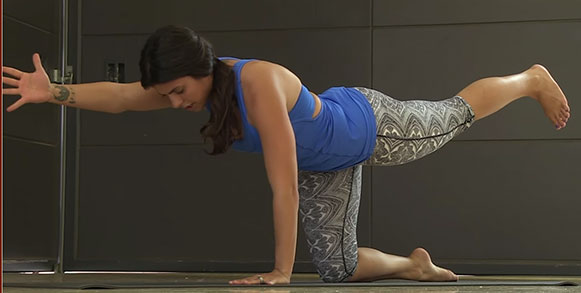
  • Get on your hands and knees with your knees on the dome-side of the ball and your hands on the floor. Lift one leg up in-line with your hip, keeping your knee bent, and press your heel toward the ceiling. Repeat up to 16 times and then switch to the other leg. A weight can be placed behind your knee for even more intensity.
Upper Body Exercises
  • Pushups
  • Perform a regular pushup, but place your hands on the platform-side of the BOSU instead of on the floor. Along with working your chest and arms, this move also works your core.
  • Back Extension
  • With the BOSU ball platform-side down, lie over the ball on your stomach with your hands under your chin. Contract your abs to lift your head and feet off the ground, extending your back. Lower and repeat while holding your abs tight, for a total of one to three sets of 8-16 reps.
  • One-Armed Row
  • Place the BOSU platform-side down, then kneel with your left knee on the dome and your right hand on the floor. Your right leg should be extended straight out behind you. With a weight in your left hand, bend your elbow and pull it to your torso. Lower and repeat for one to three sets of 8-16 reps, then switch to the other side.
Core Exercises
  • Plank
  • With the dome side down, get into a push-up position but keep your elbows straight, not bent. You can keep either your knees or toes on the ground, holding the plank position (with your abs tight) for up to 60 seconds.
  • Full Crunch
  • Place the platform side down, then lie on the ball on your back. Pull your knees into your chest and keep your hands behind your head. Squeeze your abs and lift your shoulders and hips off the dome in a full crunch. Repeat up to 16 times.

An Inexpensive Fitness Essential

The BOSU ball is on my list of inexpensive fitness essentials that you can pick up to start your own in-home gym. The home version of the BOSU ball is about $100, or there is a professional version, which is designed with extra strength in the platform, for $130, both available on Amazon.
As with most things in life, a balanced routine works best, so you'll want to avoid placing too much emphasis on cardio, strength training or any one type of activity, as this can lead to imbalances that may actually interfere with optimal health.
This is why it's so important to maintain a well-balanced fitness regimen that includes not just functional training with a BOSU ball, but also strength training, stretching, and high-intensity interval training like Peak Fitness. The use of the BOSU fits in nicely to just about any comprehensive fitness routine, and can be used with virtually all of your activities, from stretching and strength training to aerobics.

Wednesday, January 29, 2014

2 Easy Ways To Increase Willpower — Courtesy Of The Cookie Monster

Really useful to start anytime :)


I want cookie!

ways-to-increase-willpower

Willpower Is Destiny

Haven’t we all heard of Mischel’s Marshmallow Self-Control Test by now? If not, here’s a quick summary:
  1. Stick a little kid alone in a room with nothing but a marshmallow.
  2. Tell the kid they can eat it now or, if they wait 15 minutes, they get two.
  3. Then you leave the kid alone.
Some children eat the marshmallow immediately, others wait and earn two.
Big deal, right? Wrong.
It’s a huge deal.
Check with those kids 20 years later and you find this silly test of self-control predicts who gets good grades, goes to jail or gets rich.
The big shock: statistical analysis found that a child’s level of self-control is every bit as powerful a predictor of her adult financial success and health (and criminal record, for that matter) as are social class, wealth of family of origin, or IQ. Willpower emerged as a completely independent force in life success— in fact, for financial success, self-control in childhood proved a stronger predictor than either IQ or social class of the family of origin.
Watching the kids during the experiment is pretty cute:
So how do you use this to teach kids (and blog readers, for that matter) about improving self control?
Enter Sesame Street.

COOKIE COOKIE COOKIE

Sesame Street’s Cookie Monster underwent a similar trial:
The above was just a promo. In the episode there was more of a detailed lesson for Cookie Monster about fighting temptation.
How did Sesame Street assemble such a lesson? They consulted Mischel, of course.
To get the self-regulation strategies right in this segment, says Rosemarie Truglio, senior vice president for education and research, they consulted with none other than Walter Mischel, the mastermind behind the marshmallow test.
After testing so many kids, Mischel had learned a good deal about what does and doesn’t improve willpower.
What’s really important? Attention is one of the most essential elements of self-control. Distraction is a powerful tool.
How we focus holds the key to willpower, says Mischel. His hundreds of hours of observation of little kids fighting off temptation reveal “the strategic allocation of attention,” as he puts it, to be the crucial skill. The kids who waited out the full fifteen minutes did it by distracting themselves with tactics like pretend play, singing songs, or covering their eyes. If a kid just stared at the marshmallow, he was a goner (or more precisely, the marshmallow was).
So Mischel gave Sesame Street a few strategies related to attention that might help Cookie Monster.
One was a type of refocusing: “Think of the cookie as something else.” 
Mischel proposed teaching Cookie cognitive control strategies like “Think of the cookie as something else” and reminding himself of that something. So Cookie sees the cookie is round and looks like a yo-yo, and dutifully repeats to himself over and over that the cookie is a yo-yo. But then he gobbles anyway.
So that didn’t work for Cookie Monster.
ways-to-increase-willpower
But then they tried another method: Delay and focus on reward.
To help Cookie take just a nibble— a major triumph of willpower— Mischel suggested a different impulse-delay strategy. Alan tells Cookie, “I know this is hard for you, but what’s more important: this cookie now, or getting into the club where you’ll get all kinds of cookies?” That did the trick.
Success! Cookie Monster was able to hold out for the bigger plate of cookies.

How This Can Help You

I’m seriously hoping you’re already more disciplined than a five-year-old or a blue puppet.
Meaning if these methods worked for them, they’ll definitely work for you.
What are the effective strategies you can start using immediately? To review:
  1. Distract yourself. Willpower is tied to attention. Focusing on something else increases self-control.
  2. If you can’t distract yourself, just delay the impulse and focus your attention on the reward ahead.
For more tips check out my round up of self-control research and my interview with NYT bestselling author and willpower expert, Roy Baumeister.
(After all these years, how does Cookie Monster still make me smile like that every time I see him devour a cookie?)

Saturday, January 11, 2014

She was called the ugliest woman in the world

And here was her response....

Her best advice:
What defines you
Turn that negativity to something positive and I can guarantee you...you will win


Thursday, December 5, 2013

The Time You Have (In JellyBeans) - Video

What will you do with that time? Worth a watch :)

There are 28,835 beans equivalent to the number of days an average American lives.


Wednesday, August 28, 2013

Smile! Says Ellen

How I would love to see her live!


Monday, June 3, 2013

Pay it Forward (Video)

But it actually goes round back to you :)


Wednesday, May 1, 2013

Funny puppies

Something funny, yet warm and loving at the same time :) Enjoy!


Tuesday, April 23, 2013

Nike: Voices

To all the beautiful women out there, listen to your voice =)


Tuesday, February 12, 2013

The Last Pick - Jeremy Lin

He is an inspiration. I was so touched watching this. May the next generation be like him =)