Want Quick Happy tips? Head over to Marc and Angels Hack

Practical Tips for Productive Living - Wonderful Quick and effective reading articles around the wellbeing, happiness and positiveness in bullet points numbers. I personally use it for easy reference

Want quick inspiration? Inspiration Peak is the place to go!

Check out and subscribe to Inspiration Peak in my Fav Websites for everyday quotes. Works a charm every single day. You're more than welcome to suggest a quote too!

Mind, Body, Green - Ultimate Wellness articles

I love their articles for it is written by various authors coming from wellbeing, yoga, holistic nutrition background that brings you closer to nature and serenity...

Lifehacker - Tips, tricks, and downloads for getting things done

Slightly drawn towards IT tips but they do also have tips about anything and everything you need under the sun, including tips for baking and cleaning! Check them out

Showing posts with label Articles. Show all posts

Friday, February 24, 2017

Plateaus Rule! Why Plateaus can be the best thing to happen in the pursuit of your fitness

It also helps if you treat fitness as a lifestyle so that it becomes your 'norm' =)


Courtesy from ACE

You summon the strength to lift your foot one more time. Your leg feels like it is made of lead. Your foot collapses to the ground and you’ve taken another step. Time to repeat on the other side. Your heavy backpack means the sweat and heat have nowhere to go and you can feel every bit of the burden as you prepare to lift your foot, your breathing heavy and fast yet still seemingly inadequate. If only you could stop for a moment to gather your strength…
Welcome to the all-uphill, all-the-time-climb! If only the terrain would level off a bit. If only you could hit a…plateau! If you are backpacking, hitting a plateau is awesome. However, with fitness, hitting a plateau is universally seen as a negative. That’s about to change.
Webster’s Dictionary defines a plateau as:
  1. A large flat area of land that is higher than the other areas of land that surround it
  2. A relatively stable level, period, or condition
There’s nothing negative in this definition. Climbing is hard work. If you come to a “plateau” or any leveled-off spot after a period of climbing and hard work, it can be a great relief as you have the opportunity to stop and rest. This rest recharges you for the next part of the climb and gives you the strength to continue your journey.
Why then is a plateau viewed so negatively with fitness? Let’s take a look at this from a slightly different perspective.

THE ASCENT OF MOM

Here’s a story about a woman—let’s call her “mom” because she is, in fact, my mother. Mom is 370 pounds (168 kg), hasn’t been living healthfully in some time, has sleep apnea, high blood pressure, a long commute to work and family responsibilities that occupy her energy. One day, not long after my father died of a heart attack at 424 pounds (192 kg), mom decides she’s had enough of living this way and that it is time for change. Deciding to change doesn’t mean it will be easy or that it will happen overnight.
At first, although the general desire for change is there, the specific desire for taking action each day isn’t quite as strong. This is quite common. She has little willingness to start physical activity and decides to make changes to only her eating habits at first. She starts her climb.

A SERIES OF PLATEAUS

A couple of years of nutrition-only changes, and mom loses 90 pounds (41 kg). She hits a plateau and isn’t losing any more weight, but still wants and needs to. She decides she is now ready to pursue some physical activity. She begins adding a couple of walks at a park and a couple of water fitness classes each week. As a result, she starts losing more weight and, after a while, hits another plateau. She feels ready to now start adding resistance training. Her son—let’s call him Jonathan—is early in his fitness career and spends some time training his mother. Again, she hits a new round of progress, hitting a total weight loss of 170 pounds (77 kg) and is now feeling fantastic with a feeling of a new life.
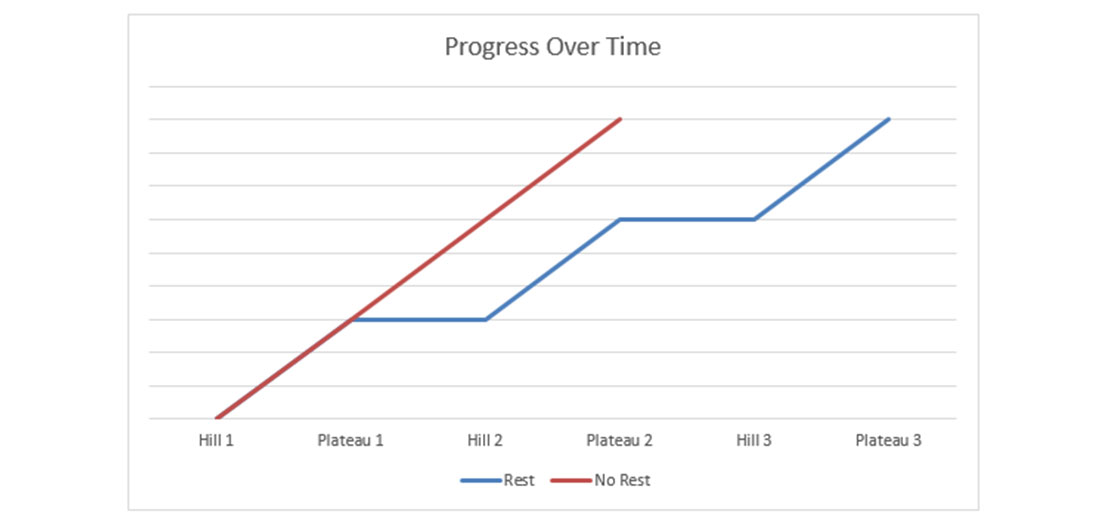
What is the pattern here? Progress, then a plateau, followed by more progress. This disrupts the “plateaus are bad” establishment. Every bit of progress came from making difficult changes and sustaining them for a period of time until they became sustainable. In this case, the plateau is actually a place of gathering the mental resources to make the next change—it is a form of rest. She never lost the progress she had gained. She just hit a plateau and gathered strength for the next change, the next climb. It looked a little bit like the blue line below.
plateaus
If we view the two graphs above as a long hike up a large mountain, which journey looks more fun to you? The red line looks positively awful as it represents making a lot of hard changes at once and sticking with them ceaselessly. Sure, you get progress in less time—but that’s only if you survive the journey. Yet, when it comes to fitness, this is the path most often chosen.

HOW LONG DID IT TAKE?

When people hear mom’s story, they most often ask “How long did it take?” with a look of hope in their eyes. Seven years, I tell them. And then I see their eyes drop and shoulders slump. She made progress and then levelled off, made progress and levelled off, and so on. She could have made progress a little faster (it would still be measured in years) if she’d taken the hard road—the red line in the chart above. That’s what most people do—and most people fail. They do too much, too soon or go on a ridiculous juice diet to try and take a short cut. It’s often miserable, short-lived and ends in failure. Those who chose the red line approach rarely reach the peak.  
Here’s the key point to remember: The pace and amount of change must be big enough to make a real and lasting difference and keep you motivated, but it must be small enough to be manageable and realistic. This is different for everyone, which is why knowing exactly what to do and when can be so challenging.

CALL TO ACTION

This is why the world needs caring and competent health and fitness professionals who will coach people through the change process rather than loud, obnoxious, shirtless, showy social-media fitness stars, whose posts actually demotivate more regular people than they motivate.
On any long, difficult journey, plateaus are your friend—a chance to rest up for the next push and reflect on the progress you’ve made to that point. Let’s start viewing them that way.

Monday, December 19, 2016

Health Hacks for the Holidays

A little tip to staying sane over the holidays :)

Stay safe, eat well, sleep well and be merry! Coz that's what holidays are all about weeeeeeeeeeeeeee


Here we go again. It’s that time of year where people start dragging out the same tired, worn-out clichés about “the holidays.”
As a health and fitness leader, you want to avoid being a cliché, too. You know who I’m talking about—the trainers who talk about working off the drinks and doughnuts and putting people through tough workouts to punish them for the sins of eating. These flawed approaches create the wrong concept of exercise in people.
If we want people to think differently about eating and exercise, we must be different. To help you help others successfully navigate the holidays, here are some helpful health hacks for the holidays. Use these with your clients and students to help them sail through the holidays while maintaining fitness, feeling positive, and starting the new year with energy and enthusiasm.
1. Define your treat days. Plan your treats on the actual holidays only—Thanksgiving, Christmas Eve or Day, New Year’s Eve, etc., or other noteworthy days like the office or church holiday party. This way, you have a game plan for a limited number of pre-determined days where you’ll allow yourself to enjoy some favored treats, and you’ll avoid the often random and endless parade of junk food that finds its way in front of you during the holidays.
define your treats
2. Define your treats. Create a list of your favorite/cherished holiday treats (no more than three) and commit to only having those during the holidays. It can be a favorite pie that a family member makes during the holidays, a special dessert that you enjoy at this time of year, or the occasional seasonal treat such as a peppermint latte. Make a list of your favorites and stick to those. And remember, a treat is an occasional thing—not an everyday thing. Having a peppermint latte is dessert, not your morning coffee.
3. It's the holi-DAYS, not the holi-MONTHS. Starting with Halloween, it seems that we often treat all of November and December as if there are no health rules. We eat and drink whatever sugary or alcoholic beverages come out way and skip workouts because “Hey, it’s the holidays, and you’ve got to celebrate.” With this perspective, it’s actually two full months—one-sixth of our entire year—that we spend derailing health with poor choices because we have to “live a little.” It’s essentially an extended sabbatical from sensible choices, and that’s too long if we want to be healthy.
move with a smile
4. Move with a smile. It can be harder to get full workouts in with travel schedules and visiting relatives. Shift the focus to doing what you can rather than what you are unable to do. Pick an activity (not exercise) that:
  • Puts a smile on your face and in your heart and/or
  • You are doing with loved ones, friends, etc.
This might sound corny, but it works. Get moving doing something you love with people you love. The positive effect on mood and mindset is almost magical. Moving while doing something fun with the important people in your life does more for you than just moving or just spending time with loved ones. The combination strengthens connections between people while enhancing the health of each individual.
5. Guarantee your workouts. Make your exercise commitment small enough so that there is no way you can’t fit it in. The busyness of the holidays often means you may not have time for your full workout, but fortunately even abbreviated workouts offer great benefits. Whatever you do has benefit so make sure you do something.Here are some ideas for you to give your clients when they are short on time:
  • Try a mini-routine of four or five of your favorite exercises and do each as a circuit for five to 10 minutes continuously.
  • If you don’t have any favorite exercises or simply want something to try, try this routine. Repeat the following three exercises as a circuit two or three times.
    1. Table-top Hip Bridge (video) (10 reps)
    2. Squat with Alternating Floor Tap – Stand with feet slightly wider than usual for a squat. Squat while reaching down with your right hand to touch the floor at the bottom of the movement. Return to standing and tap with the left hand on the next rep (20 reps, alternating hands each time)
    3. Plank Side Walk In (This is the second of the three exercises shown in this video) (10 reps, alternating sides each time)
adjust your weather mindset
6. Adjust your weather mindset. The hardest part of winter isn’t the cold; it’s all the complaining. That’s the truly endless part of winter. If you live in the upper half of North America, it’s going to be cold in the winter. This isn’t a surprise, so accept it. Find things to appreciate and be grateful for (clean, crisp air; uncrowded hiking trails, winter activities like ice skating, skiing, snowboarding and snowball fights; making snowmen and snow angels; helping your elderly neighbor shovel out, etc.) and shift your mindset to stop allowing yourself to suffer so much. Suffering is a choice. Cold weather is not.
Many people I've coached over the years experience significant anxiety about the approach of the holidays and the seemingly uncontrollable forces that propel them away from health. Applying the strategies that make the most sense for each of your clients’ situations will help ensure this never happens again. You will lead people to a different perspective, which, in turn, will lead to a different health outcome during the holidays. There is nothing more wonderful than seeing people learn to choose wisely at this time of year and then flowing right into a new year feeling great. And they will not forget the role you played in creating this new perspective.

Friday, November 4, 2016

How to help your body to Manage Cravings (5 tips)

I liked how articles would explain the science behind our feelings. And here is one: Cause of cravings and what we can do to ensure we don't overload the system.

Courtesy from Les Mills


13
The desire for food is like a swinging pendulum. 
Several times a day the pendulum swings between 
the extremes of hunger on one side and fullness on 
the other. Somewhere in middle of this arch is when 
we care little for food. This passing phase is known 
as satiety – a phase we all aim to make a little less 
fleeting.

The extremes of hunger and fullness are largely controlled by the communications between the brain (the nervous system nestled in your skull) and your ‘second brain’ (where a surprising amount of nerves and grey matter wrap in and around the digestive organs). Known as your enteric nervous system (ENS), this ‘second brain’ shares many of the same characteristics as the brain. There are billions of nerve connections and specialist regions producing their own array of neurotransmitters. However, unlike the brain, these nerves are focused on ensuring you regularly eat and that you digest what you have eaten.
The brain and ENS share many connections, so it’s not surprising that mood and stresses have a powerful impact on gut sensations and appetite control.
What your ENS does to help control hunger
As your stomach shrinks between meals, under the control of the ENS, ghrelin is released. Ghrelin is one of a number of recently discovered hormones produced by the gut that triggers feelings of either hunger or fullness. In the case of ghrelin, the rising levels in the blood trigger the nagging and incessant feelings of hunger. Once food is eaten, the levels of ghrelin in the blood fall rapidly and stay down for the next few hours, before slowing creeping up again.
Like someone constantly knocking on the door, the need to eat gradually passes from mild interruption to an overwhelming demand. It’s at the extreme end of this cycle that we will eat almost anything, with greedy need. Yet very soon this passes to fullness and potentially pain. Again the ENS triggers the sensation of fullness by firstly responding to the stretch sensors that are located on the stomach. These are powerful brakes trying to limit more food being eaten. Without these brakes there is the risk that the rest of the digestive system will be overloaded with excess food to digest. To avoid swamping the system the ENS emits pain signals and acts as a powerful brake on the rate at which the stomach empties into the small intestine. Even to the point of bursting, the ENS only allows the stomach to release a slow trickle of food for further digestion.
In the small intestine, the ENS controls the release of digestive hormones, and an entire lexicon of appetite regulation hormones – these include glucagon-like peptide (GLP), cholecystokinin (CCK), pancreatic polypeptide (PPP) and peptide YY (PYY). Each has a subtle role in helping communicate to the body and brain, not only how much has been eaten but how much protein, fat and carbohydrate was present in the meal. Protein rich meals are more potent stimulators and as a result contribute to longer lasting feelings of fullness and satiety.
The complexities of many nerves and hormones controlling hunger, appetite and satiety are not surprising when you consider how vital food is for survival. This explains why hunger signals are so powerful. Starvation has been a major factor that has shaped human evolution. A stomach-ache from overeating is then just a minor passing inconvenience in comparison to the insistent and overwhelming need to eat for the hungry. 
FIVE WELL-ESTABLISHED STRATEGIES FOR STOPPING FOOD CRAVINGS
  1. Eat before you become ravenous
It’s easy to try and skip meals when you’re frantically busy and overwhelmed. It’s only a matter of time before the powerful forces of the gut-brain axis will have you freewheeling towards food – lots of food!
  1. Slow down the rate you eat (and drink water)
A meal consumed at a leisurely pace allows your ENS to manage and control the flow of appetite regulating hormones to maximal benefit. A slow and sustained release of gut hormones will have you feeling fuller and hunger-free for hours. Water has the same effect, by providing bulk and diluting the nutrients in the digestive tract.  
  1. Avoid empty liquid calories
Sugar-sweetened beverages do little to quench hunger or bring on the feelings of fullness. They are just empty calories that have to go somewhere! Alcohol has an even more perverse effect. It stimulates hunger and provides extra calories, one sip at a time. 
  1. Choose healthy proteins
Protein rich foods including beans, legumes, pulses and grains are a glorious blend of bulk and protein. Other healthy protein options including seafood, low fat dairy and eggs also provide sustained appetite controlling benefits.
  1. Make it flavorsome
Herbs and spices have complex and unique actions on appetite regulating hormones. From the fire of chillies to the bite of cinnamon, many herbs and spices have the ability to not only reduce the amount you eat at a meal, buts also make you feel fuller for longer.
Bon appetit.
Professor David Cameron-Smith
Professor David Cameron-Smith is a regular Fit Planet contributor. A transplanted Australian, he obtained a PhD in nutritional biochemistry from Deakin University, and undertook postdoctoral training at the Royal Prince Alfred Hospital, Sydney. His research interests include the importance of nutrition in the maintenance of optimal health in an ageing population, and the impact of nutrition in regulating the function of muscles.
If you want more health and fitness inspiration simply sign up to Fit Planet and get the freshest insights and advice straight to your inbox.   
Photo credit: Dan Gold

Monday, October 24, 2016

Exercise For Each Decade of the Adult Lifespan

She's back with an interesting post: Exercises for the age group :). Have a read coz they are quite spot on....


Here’s a scary thought:
You’re the oldest you've ever been. Right. Now. 
Until we develop the ability to travel back in time, we have to accept the fact that we can't stop the aging process. Research suggests that the most effective way to minimize the effects of aging is through regular exercise and healthy lifestyle behaviors. While the following information is based on the latest understandings of how exercise slows down the aging process, going into the specific details requires more than a single blog post (if you want that info, find it here). Instead, here are some general considerations for exercise, nutrition and lifestyle choices for each decade of the adult lifespan. The good news is that a healthy lifestyle can be the proverbial fountain of youth and help you to slow down, and in some cases, reverse the effects of aging.
Here is a brief overview of exercise programs for each decade of adult development.

EXERCISING IN YOUR 20S

20s
If you’re in your 20s, enjoy your youth but realize that the sooner you commit to a healthy lifestyle the more benefits you can experience throughout your entire adulthood.
  • Experiment with different workouts to find what you enjoy and then do it on a regular basis.
  • There is no specific exercise that you should be doing, but whichever type you select make it an important component of your life. The more consistent your physical activity, the better your overall health is likely to be.
  • Consider joining a health club or attending classes at a studio. If cost is a conern, consider this fact: Either you pay to stay in shape while you’re young, or you’ll end of spending lots of money over the course of your life dealing with chronic disease and health conditions.
Age: 20s
Types of Exercise
Nutrition
Sleep
Choose activities you enjoy. When you’re young you can get away with doing high-intensity training most days of the week, but it’s important to make time for flexibility and mobility training as well.
At this stage of life, you have a high metabolism, so enjoy it.
On highly intense training days it’s important to have a good night’s sleep for optimal recovery.

EXERCISING IN YOUR 30S

30s
Aging starts accelerating in this decade of life, which may also include some of your biggest challenges including a growing career and possibly a family. This is why finding a favorite mode of exercise in your 20s is so important—it will be a regular habit by the time your career and family life start making more demands on your time.
  • Without regular exercise, cardiorespiratory efficiency (the ability to efficiently move oxygen around the body) starts to decline, which can increase the risk of developing heart disease.
  • If you’re not doing any regular physical activity around the age of 35, you will start to experience a loss of muscle mass.
  • Men in their late 30s are likely to experience lower levels of testosterone. When coupled with excessive amounts of abdominal fat, that testosterone could be converted into estradiol, a female sex hormone.
  • Strength training to increase muscle mass and metabolic conditioning for weight loss are both extremely important in this time of life. Women in their 30s should also be doing strength training, because it can help elevate levels of human growth hormone, which can help metabolize fat, promote muscle growth and help skin maintain a youthful appearance.
  • Exercise is so important during this time that if you haven’t been successful at following a regular exercise program on your own you may want to consider hiring a personal trainer or going to a studio with instructor-led workouts. Working with an ACE Certified Personal Trainer or taking classes with an ACE Certified Group Fitness Instructor can help you identify the best workouts for your needs, as well as hold you accountable for making exercise a priority in your life.
  • Even if you have a demanding schedule, it’s important to realize that even 15 to 20 minutes of exercise at a time can make a big difference and provide significant benefits.
  • As you progress through your 30s, you will want to make smarter nutrition choices and plan on going to bed earlier because the right diet combined with proper amounts of sleep are essential for good health.
Age: 30s
Types of Exercise
Nutrition
Sleep
Perform resistance training at least two or three times a week. This could include, for example, strength-training classes at a gym or performing a body-weight circuit from the comfort of your own home.
Perform cardiorespiratory training  almost every day. Find an activity that gets your heart rate up and try to do it on a regular basis. If nothing else, try to make time for walking 15 to 20 minutes at a time, three times a day (once in the morning, during lunch and again in the afternoon or evening) for health benefits.
As your metabolism changes, it is important to start paying attention to your nutrition choices. If you’re busy, try to budget your time so you can do a weekly meal preparation on Sunday so you have healthy options and won’t be tempted to grab fast food, which, while convenient, is calorically dense.

Follow the USDA guidelines and do your best to eat as many fresh fruits and vegetables as possible while limiting sugary and salty snacks.
This is the time of life when sleep starts becoming more important. Our brains repair themselves during sleep, which means that if you’re sleep deprived it could affect your performance at work and keep you from getting that promotion. In addition, the muscle-building hormones of testosterone and growth hormone are produced during the REM cycles of sleep, which is important for when you do your strength-training workouts.

EXERCISING IN YOUR 40S

40s
The first thing you notice when you hit your 40s is that you thought you would feel “older.” I’m almost halfway through this decade, yet I still feel (and sometimes act) like I’m in my 20s. However, I have noticed is that it takes longer to fully recover from high-intensity workouts, if I lose a night of sleep I’m absolutely no good the next day, and if I deviate from my regular (mostly) healthy diet for more than one or two meals I feel it almost immediately.
  • In this decade, you’re relatively ensconced in your career and family life. While there will be unforeseen challenges, you have, for the most part, established a consistent routine.
  • If you find it hard to make time for regular workouts, consider ways that you can add small bouts of exercise to your routine by bike commuting to work or identifying various strategies that can help you increase your daily level of physical activity. Including small activities, such as taking the stairs, using a standing desk at work or walking breaks at work, in your daily habits can help you burn an additional couple of hundred calories a day, which is essential for healthy weight management.
  • If you’re exercising regularly, congratulations! However, take time for a critical review of your exercise habits. If you follow the same routine for too long, your body adapts and the exercise, while good, won’t have the same effects.
  • If you’re looking for ways to change your routine consider adding yoga, which can help reduce stress levels while improving mobility, both of which can reduce the risk of disease or injury.
  • Consider adding at least one high-intensity exercise like a group-cycling, sports-conditioning or kettlebell class to your routine. High-intensity exercise can help promote muscle-building hormones while increasing caloric expenditure, both of which are important at this age. Furthermore, explosive exercises can help improve muscle elasticity, which is reduced during the aging process. Regular strength-training exercises make skeletal muscle tissue strong, but don’t challenge the elastic connective tissue that surrounds it. Adding exercises like kettlebell swings and plyometric jumps helps improve tissue elasticity.
  • Keep in mind that while some high-intensity exercise is good, it does take longer to recover. Try to limit it to three or fewer times a week and make sure you are getting plenty of sleep to help promote the recovery process.
Age: 40s
Types of Exercise
Nutrition
Sleep
Change your exercise habits so you provide fresh stimulus to your body. Continue regular strength training and cardiorespiratory exercise, but consider incorporating some high-intensity exercise to promote tissue elasticity. Yoga can help manage stress and improve your overall flexibility, both of which provide significant health benefits. If you’re not already doing yoga, consider adding it to your routine.
This is the age when you really start feeling the effects of unhealthy food choices. The good news is that you are probably earning more money so if you’re having a hard time making smart nutrition choices, you may want to consider subscribing to a service that provides fresh vegetables along with recipes or pre-packaged, proportion-controlled meals.
You don’t need me to tell you to get more sleep because this is when you really start feeling the effects of lack of sleep. Review your sleep habits and try to remove light sources like televisions and mobile devices from your bedroom because the light waves can actually wake you up as you are trying to drift off to sleep.

EXERCISING IN YOUR 50S

50s
Okay, up to this point I’ve been able to write from personal experience, but now I’m going to be going on what I’ve learned from clients, friends, relatives and the scientific literature. Once you hit your 50s, regular exercise is essential for maintaining good health. After all, this is the age when conditions like high cholesterol, heart disease or arthritis could make themselves known. If you experience any chronic medical conditions, make sure you work with your healthcare provider to identify the most appropriate types of exercise for your needs. You can, however, continue doing your favorite activities as long as they don’t cause you any severe physical discomfort.
  • In this decade of life, varying your exercise routines is important not only to keep your muscles working differently but to engage your brain as well. Make sure to include at least one or two high-intensity workouts a week, because exercise that elevates levels of growth hormone can also elevate levels of brain-derived neurotrophic factor (BDNF). This is the neurotransmitter responsible for producing new brain cells and improving cognitive function.
  • Learning new sports or activities can be another way to develop new neural pathways in your brain. If your kids are out of the house and you have more free time, you can use it to learn a new sport or start a new hobby like dancing or martial arts, all of which will provide mental as well as physical development.
  • Hopefully, your 50s is also when you will have a little more free time and disposable income to take vacations and visit parts of the world you’ve always wanted to experience. I’ve helped clients in this age bracket train for vacations like hiking to Machu Picchu, cycling across France, kayaking in New Zealand and skiing in Switzerland. If you have the luxury to enjoy these options, then picking active vacations can be one way to help keep you engaged and motivated in your exercise program. Even if you can’t afford exotic destinations you can start cycling and hiking by exploring the parks and trails in your area.
Age: 50s
Types of Exercise
Nutrition
Sleep
Choose activities that you enjoy and can do on a frequent basis. Make sure to include at least one high-intensity workout a week for optimal neuroendocrine stimulation. This is a great time to pick up a new active hobby like tennis, golf or martial arts because learning new movements stimulates brain development as well as physical development.
You’ll have to check with your medical provider on this one. You will want to avoid foods that can elevate cholesterol or affect any medications you may be taking to manage a health condition. If your kids have left the house you can enjoy nice dinners out or, even better, take cooking lessons so you can prepare nice dinners in and enjoy the company of your spouse sans kids.
Sleep is important, especially after you exercise. In this decade, you may experience sleep disruptions like waking up in the night or not being to get to sleep in the first place. If that’s the case, make sure to mention this to your healthcare provider.

EXERCISING IN YOUR 60S

60s
When you’re young, 60 seems old, but once you’re hit your 40s you quickly realize it’s not old at all (60 is the new 40, some say). If you made smart financial decisions (an entirely different blog all together), this is the decade in which you will probably retire from your career and decide what you want to do in the next phase of your life.
  • As someone who teaches workshops on how to be a personal trainer, I’ve noticed that more and more people are choosing fitness as a second career once they retire from their first. If this thought has occurred to you, here’s how to can make that transition and become an ACE Certified Personal Trainer.
  • It’s more important than ever to exercise most days of the week. You can continue to do high-intensity workouts, but limit them to two days or less for optimal recovery. If you enjoy resistance training, this may be the time to start using more machines, which make it possible to use heavier weights while minimizing wear and tear on your joints.
  • If you do retire during this decade, you will have the extra time for your workouts so continue to experiment with new types of exercises and sports to give your muscles and brain new learning opportunities.
  • Just like young adults in their 20s, taking group classes is a great way to combine physical activity with social time and, if you’re recently retired, it can be an effective way to make new friends. Aquatic fitness classes, a healthy choice at any age, are a good option for exercise because they use a lot of muscle mass while reducing stress on your joints. This is especially important if you’re dealing with any arthritis.
Age: 60s
Types of Exercise
Nutrition
Sleep
Continue to change your workouts on a regular basis to keep using your muscles in different ways. This may be the time to move away from the free weights and start using more weight-training machines, which can allow you to use heavy resistance with minimal stress on your joints. Improve your physical literacy by learning new movement skills, and if there are any activities that you didn’t do in your 60s, don’t wait—now’s the time to get going!
If you go through a major life change such as retirement and you find yourself with extra time, make sure you avoid mindless snacking. If you know you’re a muncher while puttering around the house, be sure to have plenty of healthy options and leave the sugary stuff on the grocery store shelves.
While it is important in every phase of life, sleep now becomes essential for maintaining optimal health. You may want to invest in your sleep hygiene with a new mattress.

EXERCISING IN YOUR 70S

70s
If 60 is the new 40, then 70 is the new 50. More and more, I meet people in the gym who are in this decade, but look much younger because fitness has been an integral part of their lives for years.
  • Do not let the number slow you down. Continue to participate in your favorite activities, but be smart about it by listening to your body and not forcing it to do any extremely uncomfortable exercise.
  • If you’ve been a sporadic exerciser up to this point, consider this: Staying fit and strong now can help you maintain your functional independence longer and keep you from having to rely on assisted living.
  • Resistance training is completely appropriate and can help increase lean muscle mass and improve your functional strength for activities of daily living.
  • If you feel the effects of arthritis, don’t let it stop you from cardiorespiratory exercise, but do look for types that can reduce impact on your joints.
  • Activities that require you to move your body in all directions, such as tai chi, dance or yoga, are more important than ever for helping maintain balance and reducing the risk of orthopedic injuries.
Age: 70s
Types of Exercise
Nutrition
Sleep
Strength training, especially on machines, can help enhance quality of life. Exercises that focus on multiplanar movements can help improve integrity of your myofascial system, leaving you with more youthful muscles and connective tissue that is more resilient against injury.
Keep making healthy choices. If you notice that your metabolism has started to slow down,  reduce your caloric intake and watch what you eat so you can maintain a healthy body weight.
If you experience any disruptions of your nightly sleep habits, mention it to your healthcare provider to identify a solution. The good news is that now you’ll probably have the time for afternoon naps, so feel free to indulge, especially if it gives you the energy to participate in your favorite activities.

EXERCISING IN YOUR 80S

80s
If you make it to your eighties, congratulations because currently the average adult life span in the United States is 78 years. Up to this point, I haven’t used the word old, but now is the time when you will really start to feel your age.
  • Resistance training becomes extremely important because it can help you maintain your strength, allowing you to remain functionally independent. Strength-training machines are the safest, most effective way to receive this benefit.
  • If you are considering relocating to a retirement community, look for one with a robust schedule of recreational activities so you have plenty of options for exercise.
  • You are never to old to learn new things, so consider going back to school. Social interactions and learning are both great ways to reduce the risk of developing cognitive diseases like dementia or Alzheimer’s.
  • You can continue to participate in your favorite activities but respect your age and try not to push your body beyond its existing limits.
Age: 80s
Types of Exercise
Nutrition
Sleep
Do any physical activity you enjoy and do it as often as possible. Continue to seek out new activities because learning new movement skills helps your brain as well as your body. If you’re considering moving to an older-adult community, look for one with many recreational activities.
Continue to seek and follow the advice of your healthcare provider for the best options given your current health status. Continue to avoid excessive drinking and calorically dense, low-nutrition foods. But then again, you’ve already beat the odds so enjoy yourself but be smart about it.
By now you know the importance of a good night’s sleep. Make sure to communicate any disruptions in your sleep patterns to your healthcare provider immediately.

EXERCISING IN YOUR 90S

If you're here, keep doing whatever you've been doing because it's working. Whatever physical activity you can do, do it as often as possible. If you’re not already doing strength training, ask your medical providers if they can recommend any strength-training programs specifically for your age group because you can add muscle mass at any age.
If you want to enjoy an active life well into your 90s, no matter what happens NEVER STOP EXERCISING. Even if you can only do a few minutes at a time, regular exercise and physical activity can provide health benefits in every decade. If you exercise for no other reason, do it to take control of the aging process so that you can enjoy all of your favorite activities at all stages of your life.