Want Quick Happy tips? Head over to Marc and Angels Hack

Practical Tips for Productive Living - Wonderful Quick and effective reading articles around the wellbeing, happiness and positiveness in bullet points numbers. I personally use it for easy reference

Want quick inspiration? Inspiration Peak is the place to go!

Check out and subscribe to Inspiration Peak in my Fav Websites for everyday quotes. Works a charm every single day. You're more than welcome to suggest a quote too!

Mind, Body, Green - Ultimate Wellness articles

I love their articles for it is written by various authors coming from wellbeing, yoga, holistic nutrition background that brings you closer to nature and serenity...

Lifehacker - Tips, tricks, and downloads for getting things done

Slightly drawn towards IT tips but they do also have tips about anything and everything you need under the sun, including tips for baking and cleaning! Check them out

Wednesday, May 13, 2015

Do it Better: Dynamic Warm-ups

As far as everyone is concern, warm ups are very important to prevent any injuries and to condition the muscles for a better workout. Below are some exceptionally good ones to maximise the warm up while minimising some time and of course any risks.
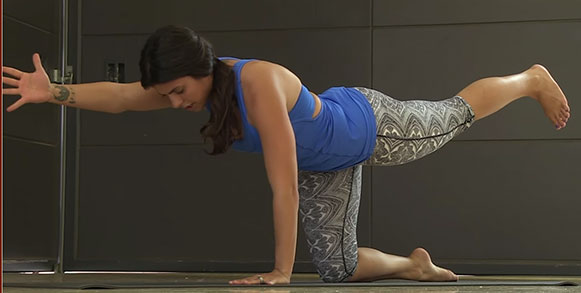


Warm-ups for cardio workouts have traditionally consisted of performing your cardio activity of choice at a lower intensity with gradual increases to higher intensity. While gradually increasing intensity is important, adding dynamic warm-ups to your clients’ routines can add multidimensional benefits to their cardio workouts. It can also serve to enhance their overall fitness and general wellness by decreasing the likelihood of overuse injuries.

Dynamic warm-ups, says Chris McGrath, founder of Movement First, a New York City-based health and fitness education, consulting and training organization, typically consist of integrated movements that help improve muscular strength, mobility, stability, balance, coordination, agility and/or even power. Warm-ups can include foam rolling, balance exercises, yoga-type movements, agility drills and even plyometric drills.

Because most cardio activities are performed with relatively small ranges of motion and are dominant in one plane (straight ahead, such as walking, running, cycling, stair climbing, elliptical, etc.), it is important to incorporate movements that move the body in more complete ways. This should include full ranges of motion, rotation and side-to-side movements.

McGrath suggests incorporating the following five movements into your clients’ dynamic warm-ups:
•“Loosen” Up. Foam rolling can help reduce excessive tension in chronically tight areas. It can also improve blood flow and circulation. If a client has a muscle that is chronically tight, taking a few moments to “loosen” that area up can be beneficial for his or her workout and protect against overuse and/or unbalanced movements.
•Extend. Most people spend much of their day sitting, which puts the knees, hips and spine in a flexed position. Counteract this tendency by incorporating movements that extend and lengthen, especially the parts that may be hunched up when sitting (hip flexors, hamstrings and upper spine).
•Use Full Range-of-motion Movements. Many clients have few opportunities to move through complete ranges of motion during the day. Therefore, they can greatly benefit by introducing full ranges of motion, even if (and perhaps especially because) the cardio workout they will be performing will not.
•Rotate. The hips and upper spine are designed to rotate more than other parts of the body. If these areas lose that ability, other parts may be required to do more rotating than they are designed to do (for example at the knees and lower back). Therefore, find ways to add mobility to the hips and mid-upper back.
•Move Sideways. Have your clients spend some time moving the body laterally. Side-to-side movements can wake up lateral stabilizers, resulting in better control and protection for when they do move straight ahead.

With countless variations and exercises to apply, these five movements provide a great framework for designing creative and effective dynamic warm-ups for your clients. And, as mentioned earlier, you can also employ the flow-based properties of yoga to transition from one movement to the next. In the following video, Jessica Matthews, M.S., E-RYT 500, senior advisor for health and fitness education for ACE, demonstrates a six-minute yoga-inspired dynamic warm-up that will help your clients get ready for just about any activity. Urge your clients to follow this warm-up prior to your sessions together or for their between-session workouts.

https://www.youtube.com/embed/zpj1hpg7ojq


For more ideas and exercises to include in a dynamic workout, check out these additional resources:

The Dynamic Warm-up Every Runner Should Try
Teach your clients how to take a few minutes to properly warm up with these multiplanar drills and you’ll be helping them run with better results for years to come.

5 Foam Rolling Exercises to Prep for a Dynamic Workout
To adequately prepare your clients for dynamic workouts, they need to do more than just a quick warm-up or a few stretches. To get the blood flowing, increase neural input to the muscles and enhance mental focus, here are five creative foam-rolling exercises that will help fire up your clients for their next dynamic workout.

Dynamic Warm-up
This continuing education course offers 25 energizing and innovative warm-up exercises to prepare your clients for superior sport performance. These techniques improve flexibility, prevent injury, reinforce proper speed movement and mechanics, elevate tissue temperature, and activate the nervous system. The dynamic warm-up sets the tone for a great workout or competition and can also be used as a stand-alone conditioning routine.

A Detailed Guide to Designing Activity-specific Warm-up and Mobility Drills
Whether you’re providing a 30-minute session for a deconditioned client or a two-hour workout for a professional athlete, these detailed guidelines and protocols will help you properly prepare your client’s body and mind for a maximally efficient training session.


Monday, May 11, 2015

The Elemelons

Something Funny!! Thanks 9Gag

Saturday, May 9, 2015

Why tidying up could change your life

I find this very very beneficial and useful. The one that sinks in the most is step 3; to never save your best perfumes. Therefore, I have started to open up ALL my toiletries gifts muahahaha...And no, I have stop collecting stuff from the hotel rooms.......

Thank you very much the guardian

‘I was surprised to be told that the ‘before’ picture doesn’t look that messy, but that’s the effect of shoving 80% of your crap into groaning cupboards and drawers.’

‘I was surprised to be told that the ‘before’ picture doesn’t look that messy, but that’s the effect of shoving 80% of your crap into groaning cupboards and drawers.’Photograph: David Levene for the Guardian

I am stuffing a letter between two books when I realise my possessions are in charge of me. It’s a hoarder’s attempt at tidying: hiding stuff inside other stuff. My coffee table groans under books, digital devices, coffee cups, lint rollers, newspapers and one or both of my kittens, Ollie and Sebastian.
Bottles of toiletries line the bathroom mirror collecting dust, and upstairs cubbyholes burst with clothes I no longer wear. Let’s not even talk about my inbox, crammed with unread emails. The Stuff is winning. Enter The Minimalists, Ryan Nicodemus and Joshua Fields Millburn, who believe that without the abundant clutter of material possessions you’re free to prioritise the stuff that matters: family, hobbies and passion projects.
Nicodemus and Millburn launched theminimalists.com in December 2010. In the first month, it attracted only 52 visitors to the site. Last year, it drew more than two million, as well as nearly 30,000 Twitter followers – and their TED talk has had more than 600,000 hits on YouTube.


Nicodemus goes to his Montana office to Skype me because he has no home internet – one of the many effects of exchanging his £80,000 lifestyle for a decluttered existence, including a four-month “experiment” of living in a cabin with Millburn.
“It wasn’t just possessions taking up my time,” says Nicodemus, who used to work as a business manager for a telephone company. “I was working 60-80 hours a week, plus I was studying, so all my free time was spent pacifying myself with an accumulation of possessions. It was a revelation that I could be deliberate with my time – and that I can work 30 or 40 hours a week and still have a great life.”
The idea of tidying up our lives, ridding ourselves of material clutter, is ancient and enduring, a practical and emotional goal we’re constantly trying to achieve – check out “storage solutions” on Pinterest to see almost fetish-like homages to tidiness. The concept is big again now with Marie Kondo’s The Life-Changing Magic Of Tidying Up currently topping the New York Times bestseller list. Now, as we claw our way out of a recession that forced many to embrace a “less is more” lifestyle, Nicodemus and Millburn have captured a moment of backlash against the endless, mindless accumulation of stuff. Here’s how I got on with their help.

Step one Decide why you’re becoming a minimalist

“I can’t tell you how many times I went for a new car, promotion or job on impulse, never asking myself why,” says Nicodemus. “So before you even start, ask yourself: how might my life be better with less stuff?”
I get down to three reasons for waging war on stuff. First, I think my time would be better spent on humans I love than wasted on objects I don’t – half a weekend is a ridiculous amount of time to spend cleaning a flat that’s not much bigger than me. Second, when I need something, I’d like to find it, not go on a quest for it. Third, I haven’t seen Sebastian in days. He’s got to be in here somewhere.

Step two Play the 30-day minimalism game

This is a way to declutter in daily steps. On day one throw out, sell, donate or recycle an item. On day two, two items. On day three, three items, and so on. After 30 days, you’ll have removed 564 items. “People resort to coathangers and paper clips in those later days,” says Nicodemus, who recommends playing the game with a friend or work colleague “and betting something – a coffee, a steak dinner. Having that accountability helps”. If you don’t know any other clutterbugs, tens of thousands of people tweet their way through the 30-day challenge using the hashtag #minsgame.
The first thing I throw out is a pair of ripped jeans. I earmark two Post-it pads to throw out tomorrow, and I already know on the third day I’ll throw out these old lint rollers and the cup with a chip on the rim. Then I think, why not just throw them out now? Long story short, I remove about 100 items on the first day.

Step three Get rid of your ‘just-in-case’ items

In most cases, any item you’ve been hanging on to “just in case” can be replaced “in less than 20 minutes for less than £10” – usually in a charity shop, or even for free online. For example, the French grammar books I kept just in case I learn French. Many JICs will never see their save-the-day moment. In a year, Nicodemus and Millburn had to replace their disposed-of JICs fewer than five times between them.
I sheepishly admit to having a JIC bag of old mobile phones. “It’s hard to throw out mobile phones,” Nicodemus says. “You think, ‘This is worth £300. To get rid of this is to get rid of £300.’ But it’s sunk cost. We hold on to things because we spent a lot of money on them five years ago, but the second you bought it you were never going to recover that money.”
I donate the phones, as well as two sacks of clothes I was keeping just in case one day they magically fit, look good, or no longer have holes.

Step four Have a packing party

“Everything is more fun if you put ‘party’ after it,” say the minimalists. In their TED talk, Nicodemus and Millburn tell the story of the day they spent packing all Nicodemus’s stuff (with “a couple of pizza deliveries”). He then unpacked items as he needed them day by day. “After three weeks, 80% of my stuff was still sitting in those boxes. I couldn’t even remember what was in most of them.”
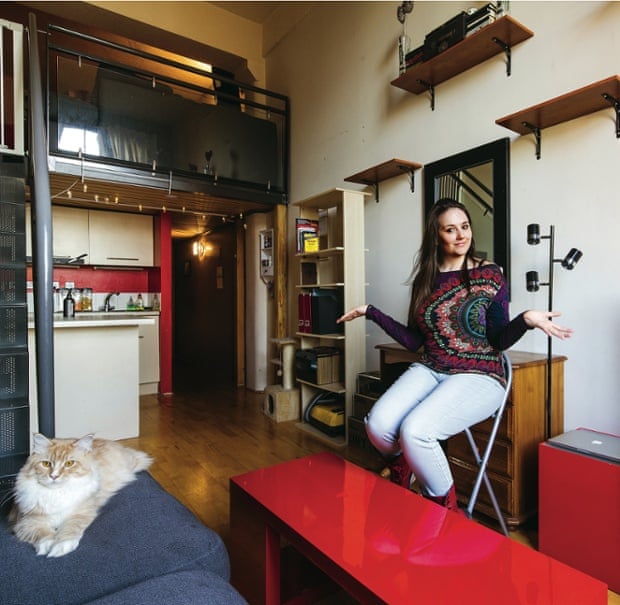
I pack up the bathroom, bedroom and living room and, as you can see from the “after” picture and my smug expression, it was pretty successful. I put away all my books, leaving only a notebook and the Italian textbooks I use weekly.
One small chest of drawers was totally empty once I cleared out the rubbish, so I donated it and put the stylish boxes that had been clogging up the corridor in its place. (Ah … in its place.) Clearing out the kitchen cupboards made space for the glasses my parents gave us as a housewarming gift. To my genuine astonishment, I too find life is fine with only the essentials and what’s in those boxes has become a mystery to me, although not an intriguing one.

Step five Digital decluttering

When you work from home, people think you’re amazing simply because you work rather than, say, sit in your pants drooling on yourself, watching Jeremy Kyle. “Well,” you get to say with a smug eye flutter, “you have to be very disciplined”. But while I’m disciplined enough to avoid Netflix during working hours, I’m not disciplined enough to avoid working during Netflix hours. I can’t even get through an episode of Better Call Saul without absentmindedly checking my emails. That’s the opposite of “living deliberately”.
“Try removing internet from your house,” suggests Nicodemus. “Start by removing email from your phone.” I compromise by placing email, WhatsApp, Twitter, Instagram and Facebook on the fifth page of my iPhone in a folder marked “Must you?”. Baby steps.

'To my genuine astonishment, I too find life is fine with only the essentials.'
Pinterest
‘To my genuine astonishment, I too find life is fine with only the essentials.’ Photograph: David Levene for the Guardian

The verdict Decluttering saved my life

Outer order has indeed contributed to inner calm in the household. I was surprised to be told the “before” picture doesn’t look that messy, but it’s only because I’d shoved 80% of my crap into groaning cupboards and drawers.
That’s the tough part: now that I live in such an ordered oasis I must resist the urge to hoard more clutter behind cupboard doors. Decluttering makes you feel like bathtime did when you were a kid: at best you procrastinate and at worst you put up a fight, but as soon as you do it you think, “That was fun: now I feel clean and can sleep. Why did I put it off?”
I do feel bad for not going all in with the digital declutter, so as a show of goodwill towards minimalism, I mark all my emails as read. All 1,184 of them. It feels amazing.

Whey-ing up the benefits

Interesting information on Whey. Do be careful when taking them, for they can cause side effects :)

Thanks Les Mills!

Whey-ing up the benefits 2015-05-06


Walking into a supplements store today can be a little overwhelming. There seems to be a supplement for everything and more and more products are coming to the market everyday. In order for exercisers to build and repair muscle, adequate protein intake is required with athletes needing slightly more protein than the average active individual. But what is the difference between different proteins?
Whey Protein
A complete protein, meaning it contains all 20 amino acids used by the body, Whey is generally branded as the best and the most commonly used protein supplement. Fast and easy to digest (providing you aren’t lactose intolerant), the liquid component (whey) is extracted from milk in the cheese making process. Whey, in addition to high protein content, contains good fats, minerals and vitamins all of which are beneficial for the body while supporting fat burning, boosting the immune system, improving insulin sensitivity, and decreasing appetite. The only disadvantage of whey is that the lactose intolerant or vegan can not consume it.
Soy Protein
Soy is renowned as one of the best non animal product sources of protein and a great alternative for vegetarians and vegans. Soy contains all nine essential amino acids, as well as good levels of zinc, potassium, iron, vitamin E and B complex vitamins. On top of this, soy has had a long history boasting the ability to lower cholesterol and prevent breast cancer. In recent years there have been an increasing amount of studies into soy to determine if the super food really is all it’s cracked up to be. Soy today is generally highly processed, and genetically modified and also appears in a large range of foods, but the jury still seems to be out on its pros and cons.
Pea Protein
For those who are lactose intolerant and are keeping a cautious distance from soy protein, pea might be the answer. Suitable for vegetarians and vegans, as well as the gluten intolerant, unlike whey and soy, pea protein does not contain allergens. Higher than other plant based protein pea protein contains the same protein content per serve as whey protein. Pea protein contains a unique combination of essential amino acids that are great for muscle growth and weight loss.
Isolate vs concentrate
Protein Isolate and Protein Concentrate are often written all over supplement packaging, but what is the difference? Protein isolate is protein concentrate broken down even further than concentrate. The further breakdown results in smaller peptides which are more easily absorbed by the muscles but at the cost of other health benefits. In the digestive process our body will break down protein concentrate further so contrary to popular belief consuming isolate does not affect our muscle fibre’s absorption of the protein and does not affect muscle building. There are arguments which support both isolate and concentrate proteins and it seems they both have great advantages.


Friday, May 8, 2015

The Moral Bucket List

One of those 'if you had a today to live?' articles that shines a little further to us readers today. It is a long article so do take some time to read, with a cup of coffee / tea of course.

Courtesy of the New York Times.

The Moral Bucket List


Credit Rachel Levit. Photography by Tony Cenicola/The New York Times

 
When I meet such a person it brightens my whole day. But I confess I often have a sadder thought: It occurs to me that I’ve achieved a decent level of career success, but I have not achieved that. I have not achieved that generosity of spirit, or that depth of character.
A few years ago I realized that I wanted to be a bit more like those people. I realized that if I wanted to do that I was going to have to work harder to save my own soul. I was going to have to have the sort of moral adventures that produce that kind of goodness. I was going to have to be better at balancing my life.
 
It occurred to me that there were two sets of virtues, the résumé virtues and the eulogy virtues. The résumé virtues are the skills you bring to the marketplace. The eulogy virtues are the ones that are talked about at your funeral — whether you were kind, brave, honest or faithful. Were you capable of deep love?
 
We all know that the eulogy virtues are more important than the résumé ones. But our culture and our educational systems spend more time teaching the skills and strategies you need for career success than the qualities you need to radiate that sort of inner light. Many of us are clearer on how to build an external career than on how to build inner character.
 
But if you live for external achievement, years pass and the deepest parts of you go unexplored and unstructured. You lack a moral vocabulary. It is easy to slip into a self-satisfied moral mediocrity. You grade yourself on a forgiving curve. You figure as long as you are not obviously hurting anybody and people seem to like you, you must be O.K. But you live with an unconscious boredom, separated from the deepest meaning of life and the highest moral joys. Gradually, a humiliating gap opens between your actual self and your desired self, between you and those incandescent souls you sometimes meet.

So a few years ago I set out to discover how those deeply good people got that way. I didn’t know if I could follow their road to character (I’m a pundit, more or less paid to appear smarter and better than I really am). But I at least wanted to know what the road looked like.


Credit Rachel Levit. Photography by Tony Cenicola/The New York Times

I came to the conclusion that wonderful people are made, not born — that the people I admired had achieved an unfakeable inner virtue, built slowly from specific moral and spiritual accomplishments.
If we wanted to be gimmicky, we could say these accomplishments amounted to a moral bucket list, the experiences one should have on the way toward the richest possible inner life. Here, quickly, are some of them:
 
THE HUMILITY SHIFT
We live in the culture of the Big Me. The meritocracy wants you to promote yourself. Social media wants you to broadcast a highlight reel of your life. Your parents and teachers were always telling you how wonderful you were.
But all the people I’ve ever deeply admired are profoundly honest about their own weaknesses. They have identified their core sin, whether it is selfishness, the desperate need for approval, cowardice, hardheartedness or whatever. They have traced how that core sin leads to the behavior that makes them feel ashamed. They have achieved a profound humility, which has best been defined as an intense self-awareness from a position of other-centeredness.
 
SELF-DEFEAT
External success is achieved through competition with others. But character is built during the confrontation with your own weakness. Dwight Eisenhower, for example, realized early on that his core sin was his temper. He developed a moderate, cheerful exterior because he knew he needed to project optimism and confidence to lead. He did silly things to tame his anger. He took the names of the people he hated, wrote them down on slips of paper and tore them up and threw them in the garbage. Over a lifetime of self-confrontation, he developed a mature temperament. He made himself strong in his weakest places.
 
THE DEPENDENCY LEAP
Many people give away the book “Oh, the Places You’ll Go!” as a graduation gift. This book suggests that life is an autonomous journey. We master certain skills and experience adventures and certain challenges on our way to individual success. This individualist worldview suggests that character is this little iron figure of willpower inside. But people on the road to character understand that no person can achieve self-mastery on his or her own. Individual will, reason and compassion are not strong enough to consistently defeat selfishness, pride and self-deception. We all need redemptive assistance from outside.

People on this road see life as a process of commitment making. Character is defined by how deeply rooted you are. Have you developed deep connections that hold you up in times of challenge and push you toward the good? In the realm of the intellect, a person of character has achieved a settled philosophy about fundamental things. In the realm of emotion, she is embedded in a web of unconditional loves. In the realm of action, she is committed to tasks that can’t be completed in a single lifetime.
 
ENERGIZING LOVE
Dorothy Day led a disorganized life when she was young: drinking, carousing, a suicide attempt or two, following her desires, unable to find direction. But the birth of her daughter changed her. She wrote of that birth, “If I had written the greatest book, composed the greatest symphony, painted the most beautiful painting or carved the most exquisite figure I could not have felt the more exalted creator than I did when they placed my child in my arms.”
That kind of love decenters the self. It reminds you that your true riches are in another. Most of all, this love electrifies. It puts you in a state of need and makes it delightful to serve what you love. Day’s love for her daughter spilled outward and upward. As she wrote, “No human creature could receive or contain so vast a flood of love and joy as I often felt after the birth of my child. With this came the need to worship, to adore.”
THE CALL WITHIN THE CALL
We all go into professions for many reasons: money, status, security. But some people have experiences that turn a career into a calling. These experiences quiet the self. All that matters is living up to the standard of excellence inherent in their craft.
Frances Perkins was a young woman who was an activist for progressive causes at the start of the 20th century. She was polite and a bit genteel. But one day she stumbled across the Triangle Shirtwaist factory fire, and watched dozens of garment workers hurl themselves to their deaths rather than be burned alive. That experience shamed her moral sense and purified her ambition. It was her call within a call.

After that, she turned herself into an instrument for the cause of workers’ rights. She was willing to work with anybody, compromise with anybody, push through hesitation. She even changed her appearance so she could become a more effective instrument for the movement. She became the first woman in a United States cabinet, under Franklin D. Roosevelt, and emerged as one of the great civic figures of the 20th century.
 
THE CONSCIENCE LEAP
In most lives there’s a moment when people strip away all the branding and status symbols, all the prestige that goes with having gone to a certain school or been born into a certain family. They leap out beyond the utilitarian logic and crash through the barriers of their fears.
The novelist George Eliot (her real name was Mary Ann Evans) was a mess as a young woman, emotionally needy, falling for every man she met and being rejected. Finally, in her mid-30s she met a guy named George Lewes. Lewes was estranged from his wife, but legally he was married. If Eliot went with Lewes she would be labeled an adulterer by society. She’d lose her friends, be cut off by her family. It took her a week to decide, but she went with Lewes. “Light and easily broken ties are what I neither desire theoretically nor could live for practically. Women who are satisfied with such ties do not act as I have done,” she wrote.
She chose well. Her character stabilized. Her capacity for empathetic understanding expanded. She lived in a state of steady, devoted love with Lewes, the kind of second love that comes after a person is older, scarred a bit and enmeshed in responsibilities. He served her and helped her become one of the greatest novelists of any age. Together they turned neediness into constancy.

Commencement speakers are always telling young people to follow their passions. Be true to yourself. This is a vision of life that begins with self and ends with self. But people on the road to inner light do not find their vocations by asking, what do I want from life? They ask, what is life asking of me? How can I match my intrinsic talent with one of the world’s deep needs?
 
Their lives often follow a pattern of defeat, recognition, redemption. They have moments of pain and suffering. But they turn those moments into occasions of radical self-understanding — by keeping a journal or making art. As Paul Tillich put it, suffering introduces you to yourself and reminds you that you are not the person you thought you were.
The people on this road see the moments of suffering as pieces of a larger narrative. They are not really living for happiness, as it is conventionally defined. They see life as a moral drama and feel fulfilled only when they are enmeshed in a struggle on behalf of some ideal.
This is a philosophy for stumblers. The stumbler scuffs through life, a little off balance. But the stumbler faces her imperfect nature with unvarnished honesty, with the opposite of squeamishness. Recognizing her limitations, the stumbler at least has a serious foe to overcome and transcend. The stumbler has an outstretched arm, ready to receive and offer assistance. Her friends are there for deep conversation, comfort and advice.
External ambitions are never satisfied because there’s always something more to achieve. But the stumblers occasionally experience moments of joy. There’s joy in freely chosen obedience to organizations, ideas and people. There’s joy in mutual stumbling. There’s an aesthetic joy we feel when we see morally good action, when we run across someone who is quiet and humble and good, when we see that however old we are, there’s lots to do ahead.
The stumbler doesn’t build her life by being better than others, but by being better than she used to be. Unexpectedly, there are transcendent moments of deep tranquillity. For most of their lives their inner and outer ambitions are strong and in balance. But eventually, at moments of rare joy, career ambitions pause, the ego rests, the stumbler looks out at a picnic or dinner or a valley and is overwhelmed by a feeling of limitless gratitude, and an acceptance of the fact that life has treated her much better than she deserves.
 
Those are the people we want to be.

Wednesday, May 6, 2015

The Fourth Trimester – AKA Why Your Newborn Baby is Only Happy in Your Arms

Now some of you may agree, or disagree to this. It just makes sense to me most as a mother and provides a relief of course. These poor little things are so thrown off the moment they come to the world. They have just too much happening for their little bodies all at the same time. The first 2 really happens to me often but not always. I know that at the end of the day it's intuition that will guide us all. And of course, spending time :)

See if it works for you too!

Thank you Sarah Ockwell.

“My baby is only happy in my arms, the minute I put her down she cries”

“He sleeps really well but only when he’s laying on my chest, he hates his moses basket”

“She cries every time we lay her on her play mat”

“He hates going in his pram, he cries the second we put him in it”.


If I had a pound every time I heard these from a new parent I’d be a very rich lady by now! What amazes me though is that society in general doesn’t get it, they don’t get why so many babies need to be held by us to settle and what perplexes me even more is that we do spend so long trying to put them down! We spend more than time though, the ‘putting babies down’ industry is worth millions, rocking cribs, battery swings, vibrating chairs, heartbeat teddies and the list goes on………………having been a first time parent who bought all four of the items listed above I am embarrased to admit now it honestly didn’t enter into my head that perhaps the answer was to *not* put my baby down and I certainly didn’t consider why these things might help. It took me a long time to understand and empathise with my baby, to see the world through his eyes so to speak.

“Empathy: the intellectual identification with
or vicarious experiencing ofthe feelings,
thoughts, or attitudes of another.”

To empathise with our newborns feelings we need to put ourselves in their place, to imagine experiencing their world – but which world? The world they have spent most of their life in, their ‘womb world’ or the world they are in now – our world. To fully understand we must appreciate the enormous transition they have made – a concept known to many as ‘The Fourth Trimester’ -some make the womb to world transition easily, others less so and it is this latter group in particular “the clingy babies” we can learn so much from through this concept.

“Birth suddenly disrupts this organization. During the month following birth, baby tries to regain his sense of organization and fit into life outside the womb. Birth and adaptation to postnatal life bring out the temperament of the baby, so for the first time he must do something to have his needs met. He is forced to act, to “behave.” If hungry, cold, or startled, he cries. He must make an effort to get the things he needs from his caregiving environment. If his needs are simple and he can get what he wants easily, he’s labeled an “easy baby”; if he does not adapt readily, he is labeled “difficult.”” – Dr. William Sears.
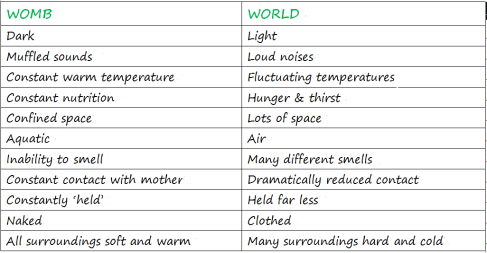
So lets quickly compare the two different ‘worlds’ your baby has lived in:

Image

Pretty different huh? On top of this the big thing to understand is that in utero the baby’s world was constant, each day was the same, the stimulation didn’t change, but now they are born each day is different – ever changing, ever stimulating!


The concept of the fourth trimester helps us to understand the transition a newborn must make over their first few weeks earthside and once we understand we find so many ways we can help – but to me the most important facet of the fourth trimester is parental understanding and empathy, once that exists everything else will flow naturally.

Here are some common newborn calming techniques that tend to work quite well, but remember each and every baby is different, if you don’t already know, you will soon learn what your baby likes best and that’s what matters, that it is unique to *your* baby. Prescriptive ‘do this/don’t do this’ baby calming lists don’t help anybody – because they forget they are dealing with individuals – both parents and babies! Some things on this list will be inappropriate for you and your baby, some simply won’t work, some you won’t like – and that’s OK! because really it isn’t about these tips it’s about you and your baby getting to know each other!

Movement
The womb is a constantly moving space, Braxton Hicks would squeeze your baby at the end of pregnancy and each time you moves your baby was wobbled around inside. Imagine how walking upstairs feels for a baby in utero! Babies tend to love movement but so often we put them down somewhere completely still. You could try dancing, swaying from side to side, going for an exaggerated quick walk or bumpy car ride.

Skin to Skin Contact
Such a brilliant baby calmer! Being in contact with your warm, naturally (un)scented, skin is heaven for a baby, it helps to stabilise their body temperature, heart rate and stress hormones and stimulates the release of oxytocin – the love and bonding hormone – in you both. Topless cuddles, shared baths, baby massage and bedsharing are all great skin to skin experiences for your baby and you.

Bed-Sharing
Sharing a bed with your baby is an amazing way of getting more sleep for everyone, babies are generally much calmer and sleep more easily if they sleep with you in your bed, yet it is such a taboo topic and although 60% of parents will share a bed with their baby at some point it’s a subject that makes society very uncomfortable, but…it is an *amazing* baby calmer! It’s really important that you think about how bedsharing will work and follow some important safety guidelines HERE.

Swaddling

Imagine how snug your baby was at the very end of your pregnancy inside of you – now imagine how strange it must feel to them after they have been born and have so much space around them! The absolutely best thing you can do is to envelop your baby in your arms, but for times when you don’t want to or indeed can’t then swaddling is an option. Swaddling is becoming increasingly popular, however there are important safety guidelines to be followed if you choose to swaddle your baby, if you are breastfeeding please make sure feeding is established before swaddling and take care not to miss your baby’s hunger cues if you are feeding on demand:
  • Never swaddle over your baby’s head or near his face
  • Never swaddle your baby if he is ill or has a fever
  • Make sure your baby does not overheat and only swaddle with a breathable/thin fabric
  • Only swaddle your baby until he can roll over**
  • Always place your baby to sleep on his back
  • Do not swaddle tightly across your baby’s chest
  • Do not swaddle tightly around your baby’s hips and legs, his legs should be free to “froggy up” into a typical newborn position.
  • Lastly start to swaddle as soon as possible, do not swaddle a 3 month old baby if he has not been swaddled before.
** The American Academy of Paediatrics recommends swaddling for babies 0-14wks.

Babywearing

Wearing your baby in a sling is one of the ultimate ways to keep them calm and happy. It increases the time a baby spends in a state of “quiet alertness” – a time of contentment when they learn the most. When a baby is in utero they spend 100% of their time in physical contact with us – yet the moment they are born this is estimated to drop to only 40%! Babywearing also means 2 free hands!
Choose your sling carefully. A good sling will be easy to use and will support both yours and your baby’s spine whilst not placing any pressure on your baby’s growing hips – newborns should always be carried facing inwards with a “frog leg” pose, not a crotch dangle pose so commonly used by commercial baby carriers. Also seek to carry in an ‘in arms’ position – i.e: how your baby would be held if you were holding them! This great picture from JePorteMonBebe highlights this newborn hold position perfectly.

Babywearing is a great way for dads to bond with babies!

It is quite common for a baby to cry once placed in a sling, this does not mean that they hate the sling – it just means that you need to move, so get dancing! As with swaddling,babywearing is becoming increasingly popular, however there are important safety guidelines to be followed, the TICKS acronym below neatly sums them all up:

Image

Position
The “tiger in the tree” position below, taken from baby yoga, is often magical, stopping a crying baby in an instant!

Noise
Babies love sound, but for many not the sound you might think. For many babies a hoover is much more calming to a baby than a lullaby. A special white noise CD, such as THIS, can be played on loop whilst your baby sleeps to help keep them calm.

Feed
If your baby is hungry nothing will calm him, so watch for his hunger cues. Feeding is always better if it is baby led, not led by a routine – whether you are breast or bottle feeding. Remember as well that your baby may not always be hungry for a full feed, they may want a quick drink, a quick snack or just some comfort sucking. Babies also find sucking the ultimate relaxation and comfort tool. Sucking helps a baby’s skull bones to return to their normal position after birth as well as providing them with comfort and security. If you are not breastfeeding you might find your baby will relax when given a dummy/pacifier.

Deep Bathing
The womb is a wet, warm place. The world as we know it is dry and cold! Sometimes a nice deep, warm bath can stop a baby’s tears in seconds – even better if mummy or daddy goes in the big bath with baby too as skin to skin contact is a wonderful baby calmer.

Outside
If all else fails many babies stop crying the minute they hit the open air – I’m not sure if this is because we are usually moving (e.g.: walking over cobbles with the buggy/ bouncing in a sling and the drone and movement of a car) or because of the change in air – but it works!

What have you found calms your newborn?

Sunday, May 3, 2015

This Is Why Your Baby Doesn’t Sleep Through The Night

One of the answers that makes sense to me. Yes, parenthood qualms and this is definitely a commone question. I have to agree that they DO have a small tummy and it empties really quickly!

See if this works for you :). Some answers may be of relief.

Courtesy of Buzzfeed.

“How’s the baby doing? Sleeping through the night yet?”
This line will be familiar to parents of small children. The unbroken, “normal” night’s sleep is the holy grail of parenting. Gwyneth Paltrow’s daughter might have started sleeping through the night from six weeks, but for most families that’s a distant dream.

It’s perhaps the most talked-about topic on online forums, and there’s an entire publishing industry based on the idea that with the right training, babies can and should sleep more.

Here, BuzzFeed News speaks to two leading experts to find out why babies wake up during the night – and why it might actually be a good thing.
Sian Butcher / BuzzFeed

1. Why do babies wake up? Because they’re supposed to.

For Peter Fleming, professor of infant health and developmental psychology at the University of Bristol, the idea that babies should sleep through the night is a 20th-century idea. It’s more natural for them to wake up, often.
“Human infants are not designed to sleep for long periods, it’s not good for them, and there is absolutely no evidence whatsoever that there is any benefit to anybody from having a child that sleeps longer and consistently,” he tells BuzzFeed.

“That’s not perhaps what most parents would like to hear.”

2. In fact, nobody really sleeps through the night, even adults.

Darcia F. Narvaez, professor of psychology at Notre Dame University, says that one of the main misconceptions parents have is that everyone normally sleeps eight hours. We don’t.
“Adults don’t sleep through the night either, they just forget that they’re waking up routinely,” she tells BuzzFeed. “We jam all our sleep into eight hours because we work during the day and that’s just not normal if you look at the history of humanity.
“It’s normal to have periods of waking up and short sleeps. With hunter-gatherers, they sleep for two hours and then they’re awake and that’s for the whole 24 hours.”

3. Human babies are born earlier in their development than other animals – they need close contact or an “external womb”.

“Human babies are born 9 to 18 months early compared to other animals,” says Narvaez. “Other animals are able to walk around and start eating – we can’t do that. We look like foetuses when we’re born and we are.
“So that means you want to keep that baby calm while the brain systems are finishing because they only have 25% of the adult brain-size developed, and a lot of systems haven’t set their thresholds and parameters yet. They’re expecting good care – like in an external womb or nest. We call it the evolved developmental niche or nest.”

4. Babies who wake up a lot are actually associated with higher levels of intelligence and better mental health.

There is, according to Fleming, a link between “very high levels of developmental and intellectual achievement and not sleeping throughout the night,” while Narvaez says that children who are kept closer to their parents and have their needs more readily met have “greater empathy and more self-regulation, they have greater conscience, and one study showed they had more cognitive ability and less depression.”

5. Babies have a much shorter sleep cycle than adults.

“Adults tend to go through a 90-minute sleep cycle and come up almost or perhaps completely to the point of waking up and then go back to sleep,” says Fleming.
“We tend to have two or three of those during the night time before we become aware that we’ve woken and go back to sleep. Babies have a 60-minute cycle.”
What this means is that it’s normal for babies to fidget and wake – and unlike adults, they struggle to get back to sleep by themselves.

6. Babies need their parents to stay calm, and leaving them to cry seriously stresses them out, even if they’re quiet.

A 2011 study found that babies do eventually learn to stop crying when left to settle themselves through “sleep training” or “controlled crying”. But while this decreased the stress levels of parents in the study, the level of stress in the babies went up.
Narvaez explains: “So what you’ve taught baby is that it doesn’t pay to signal. The baby’s body goes through a cycle: At first it’s comfortable, then they start to feel the stress hormones start to increase and hopefully the parent is there to calm them down, which is training them to keep their stress response steady at a calm level.

“If the parent still doesn’t come, the sympathetic system is kicking in – it’s fight or flight, you gotta hurry, you’re going to die here if you don’t get attention. If that doesn’t work then you go into the parasympathetic system and it makes you freeze or faint. That is an extreme reaction, but it’s there so you don’t use up all your energy and die.”

7. Babies sleep through the day and wake up at night to make sure they get your undivided attention.

“Typically, babies love sleeping during the day, and 6pm to midnight is the time they’re going to want to be awake the most,” says Fleming.
“Actually, biologically that’s a big advantage because they will have more attention from their two primary caregivers at that time of day than at any other, because there are fewer distractions. From a biological point of view what the baby is doing is completely normal and sensible. It just doesn’t fit in with our 21st-century expectations.”

8. Babies aren’t supposed to be apart from their parents, whether in a separate room or even in their own bed.

“If we go back to evolutionary history of humans,” Fleming says, “babies spent all their time in close and continual contact with their mum, they get carried around everywhere.
“I’ve quite done a lot of work in Africa and in various other places and babies are carried around with their mother all the time. They’re asleep when they need to sleep and they’re awake when they need to be awake, but they’re constantly with their mother and that facilitates breastfeeding.
“If the baby is constantly with mum, the idea that they need to sleep for long periods of time doesn’t really arise. In most parts of the world and most infants on this planet, that is still the case.”
Fleming says there is evidence to show a higher risk of sudden infant death syndrome (also known as cot death) among babies that are kept in separate rooms.

9. That’s why co-sleeping is such a popular technique across the world: Babies crave personal contact and can get upset when they don’t get it.

Fleming argues that co-sleeping – sharing a bed with your baby – is far more common across the world than some people might think.
“The idea that sharing a sleep surface with your baby is in anyway wrong, abnormal or peculiar is just nonsense,” he says. “Most people in the world would see that view as bizarre – 90% of the human infants on this planet sleep that way every night and over the half a million years of human evolution that’s been the norm.”
Fleming admits that while it’s not possible for working parents to be with their children constantly, there can be compromises, such as being in as close contact as possible while they are with their kids.

Despite what you might hear, and though it might try your patience, it’s natural for babies to wake in the night.

Babies are attuned to having their needs met by a primary caregiver throughout the night, in close contact, with lots of feeding. And there isn’t much we can do about it.
As Fleming puts it: “One needs to remember that society changes faster than biology. A biological pattern that’s taken half a million years to develop can’t just be suddenly ignored and turned around. Particularly when there’s no advantage in doing so.”